
Why Black Specks Keep Coming Back After Purging

A Troubleshooting Guide for Injection Molding and Extrusion Processors
Black specks disappear after purging. Production resumes. Parts look clean. Then, several hours or a few hundred cycles later, the black specks return.
PEKUTHERM® Plastics Podcast: Why Black Specks Keep Coming Back
For plastic injection molders and extrusion processors, recurring black-speck contamination can mean rejected parts, wasted resin, additional labor, repeated purging, and unexpected production downtime.
The natural reaction is to purge the machine again.
If black specks keep returning, the problem may not be how much material is being flushed through the equipment. It may be what remains inside—or what continues creating contamination.
Understanding that distinction is the first step toward a more effective cleaning strategy.
1. Black Specks Are a Symptom, Not a Diagnosis
Black specks are small, dark particles that appear on the surface of, or embedded within, molded and extruded plastic products.
They can originate from several sources:
Thermally degraded or carbonized polymer
Residual material from previous production runs
Contaminated virgin resin, additives, or regrind
Excessive processing temperatures or residence time
Material trapped in dead spots or low-flow areas
Foreign particles introduced through material handling
Equipment wear or deteriorating components
Not every black particle is carbon. The first objective should be to identify the source rather than immediately assume the barrel needs additional purging.
2. Why Black Specks Return After Purging
Residual polymer remains attached to internal surfaces
Inside an injection molding machine or extruder, polymer encounters:
Changing temperatures,
pressure, shear,
and flow conditions.
Over time, small amounts of material can remain attached to barrel walls, screw flights, and other processing surfaces.
These deposits may gradually degrade or carbonize.
When processors flush a machine with additional production resin, the flowing material may displace much of the previous polymer without removing every deposit attached to the metal.
The machine initially appears clean.
But as production continues, changes in melt flow, temperature, and pressure can dislodge retained contamination.
Those particles reenter the melt stream.
The black specks return because the original source was never fully addressed.
Dead spots retain material longer.
A dead spot is an area where polymer movement is restricted or stagnant compared with the main melt stream.
Potential contamination-retention areas include:
Screw roots, flights, and mixing sections
Barrel transitions
Screw tips and check rings
Injection nozzles
Hot runners and gates
Extrusion adapters and screen changers
Die heads and downstream flow channels
These areas vary depending on equipment geometry.
For example, a barrel may be relatively clean while degraded material remains in an injection molding nozzle or extrusion die.
This explains why some processors continue seeing contamination even after repeated barrel purging.
The contamination may be coming from a component the purge has not adequately cleaned.
3. Excessive Heat Can Create New Black Specks
Not every recurring black-speck problem comes from old contamination. Sometimes, the process itself continues generating degraded polymer.
Three conditions deserve particular attention.
Melt temperature: Excessive processing temperatures can accelerate polymer degradation. Actual melt temperature can exceed barrel setpoints because of shear heating.
Residence time: Material held too long at processing temperature may degrade, especially during production interruptions or when shot size is small relative to barrel capacity.
Mechanical shear: Excessive screw speed, back pressure, or unsuitable screw geometry can generate additional heat and increase degradation risk.
For extrusion applications, material retained in low-flow die-head or adapter regions can experience extended thermal exposure.
In these situations, purging may temporarily eliminate visible contamination, but processing conditions can produce additional black specks.
A sustainable solution must address both equipment cleanliness and the conditions responsible for degradation.

4. Troubleshooting Recurring Black Specks
Before using more purge material, examine when and where contamination appears.
Observation | Possible cause | What to investigate |
Black specks appear at startup | Retained degraded polymer | Shutdown procedures and residence time |
Specks return after purging | Deposits remain on internal surfaces | Screw, barrel, nozzle, and downstream components |
Contamination increases during production | Ongoing thermal degradation | Melt temperature, shear, and residence time |
Specks appear after adding regrind | Contaminated feedstock | Regrind quality and material handling |
Specks occur with certain molds or dies | Localized retention areas | Hot runners, gates, adapters, and dies |
Repeated purging produces little improvement | Unresolved source or equipment condition | Targeted inspection and maintenance |
Five steps to identify the source
Step 1 — Document the contamination pattern.
Record when black specks appear, whether they increase over time, and which materials or operating conditions are involved.
Step 2 — Evaluate incoming materials.
Check virgin resin, regrind, colorants, additives, conveying equipment, and material storage.
Step 3 — Review processing conditions.
Compare actual melt temperature, residence time, screw speed, and back pressure with the resin manufacturer’s recommendations.
Step 4 — Identify retention areas.
Investigate the screw, barrel, check rings, nozzles, hot runners, adapters, and dies as appropriate.
Step 5 — Apply the appropriate corrective action.
Use the correct cleaning method, adjust the processing conditions where necessary, and monitor production to determine whether contamination returns.
Changing one relevant variable at a time, when practical, makes the results easier to interpret.
5. Material Displacement Is Not Always Mechanical Cleaning
One common response to contamination is to continue running production resin through the equipment until black specks disappear.

This approach can be effective for straightforward material transitions and contamination that is easily displaced.
However, it may be less effective when degraded polymer remains attached to internal surfaces.
The distinction is important.
Material displacement moves existing polymer through the machine.
Mechanical cleaning is intended to physically loosen and remove retained material from processing surfaces.
Some conventional flushing procedures can leave deposits behind even when the discharged material initially appears clean.
Repeated flushing may consume additional resin without addressing the source of recurring contamination.
This is where the cleaning mechanism of a dedicated mechanical purging compound becomes relevant.
6. How PEKUTHERM® Mechanically Removes Retained Contamination
PEKUTHERM® is a thermoelastic mechanical purging compound supplied by UniTemp for plastic injection molding and extrusion applications.
Unlike purging methods that rely primarily on carrier-resin dilution or chemical reactions, PEKUTHERM uses a physical, thermoelastic cleaning mechanism.
The thermoelastic soft-scouring action
During processing, PEKUTHERM softens into a flexible, pencil-eraser-like consistency. Its self-adhering properties allow the material to form a soft-scouring mass that moves through the processing equipment.
As the compound advances, it helps:
Contact internal metal surfaces where degraded material may accumulate.
Mechanically loosen retained polymer and carbon buildup through its thermoelastic cleaning action.
Collect and carry dislodged contamination within the moving purge material.
Transport the collected residue through the equipment’s normal discharge path, following the appropriate machine-specific purging procedure.
This distinction is central to PEKUTHERM’s cleaning mechanism.
The compound does not simply push clean material past contamination. It is engineered to mechanically loosen deposits and transport removed material out of the processing system.
PEKUTHERM does NOT depend on:
Chemical reactions,
soaking time,
or carrier-resin dilution.
During normal production purging, it is designed to exit without leaving carrier-resin residue.
Cleaning effectiveness depends on the selected formulation, processing conditions, equipment geometry, and access to contaminated surfaces.

7. PEKUTHERM® Processing Temperatures and Formulations
PEKUTHERM offers formulations for standard, high-temperature, and ultra-low-temperature applications.
The correct formulation depends on:
Application type,
machine size,
processing temperature,
and equipment configuration.
PEKUTHERM® Processing Temperature & Formulation Guide
Temperature category | Processing range | Injection molding | Extrusion |
Standard | 375°F–572°F (190°C–300°C) | N, SM, SK | EX |
High | 300°F–752°F (149°C–400°C) | HLT, HLT Fine | HLT |
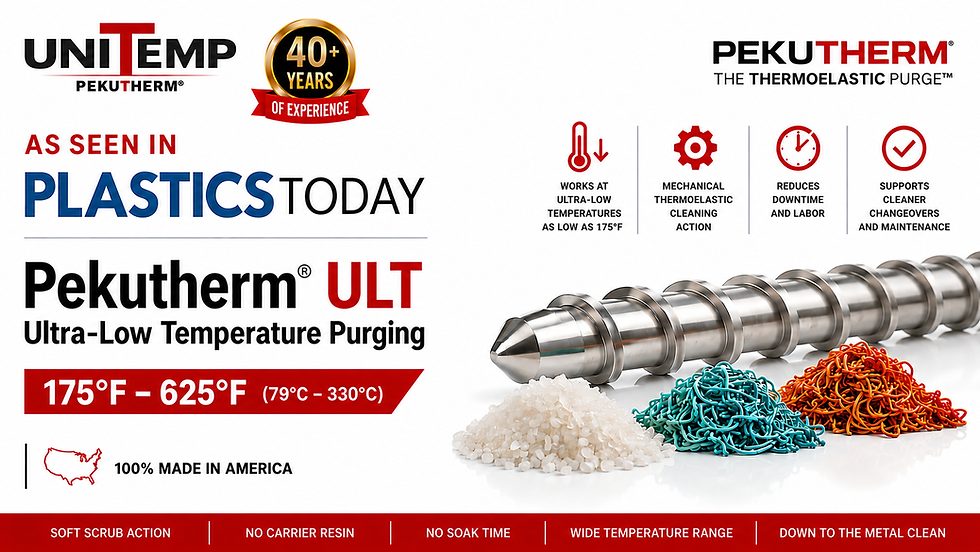
Ultra-Low | 175°F–625°F (79°C–330°C) | ULT, ULT Fine | ULT |
Standard-temperature injection molding machine sizes:
N: 150 tons and larger
SM: 80–150 tons
SK: 80 tons and smaller
Selection at overlapping machine-size boundaries should be confirmed for the specific application.
Technical note: These processing ranges indicate PEKUTHERM formulation compatibility, not recommended machine temperature setpoints. Follow the appropriate product instructions and contact UniTemp for application-specific guidance.
8. How Do You Know the Machine Is Actually Clean?
The disappearance of visible black specks is encouraging, but it does not necessarily establish that the original contamination source has been eliminated.
A more useful verification process examines what happens after the purge.
Consider monitoring:
Visible contamination in discharged purge material
Initial production parts or extrudate
Rejected parts and startup scrap
Purge material consumption
Time required to resume acceptable production
Whether black specks return after stable operation resumes
These observations help confirm that degraded polymer and contamination have been removed.
If contamination persists, investigate whether additional cleaning, targeted maintenance, or process adjustments are necessary.
Some problems cannot be corrected by purging alone.
Worn components, inaccessible deposits, and equipment defects may require mechanical inspection or repair.
9. Preventing Black Specks Before They Interrupt Production
Recurring contamination should not automatically become an accepted cost of manufacturing.
A preventive approach combines suitable processing conditions with scheduled cleaning and equipment maintenance.
For injection molding and extrusion operations, this may include:
Maintaining appropriate melt temperatures
Reducing unnecessary residence time
Following material-specific startup and shutdown procedures
Monitoring resin and regrind quality
Inspecting contamination-prone components
Establishing a repeatable purging procedure
Recording cleaning performance and recurrence patterns
PEKUTHERM mechanical purging can be incorporated into an existing preventive maintenance program to help address retained degraded polymer and carbon buildup before they contribute to production defects.
The objective is not simply to purge more frequently.
It is to establish a cleaning strategy appropriate for the machine, material, and contamination risk.
Frequently Asked Questions
Why do black specks return after purging an injection molding machine?
Recurring black specks may be caused by degraded polymer retained on internal surfaces, material trapped in check rings or hot runners, contaminated feedstock, or processing conditions that continue creating degradation.
Can black specks originate inside an extrusion die?
Yes. Material retained in adapters, die heads, screen-changing equipment, or other low-flow regions can degrade and subsequently enter the melt stream. Barrel cleaning alone may not resolve every downstream source.
Are black specks always carbon buildup?
No. Dark particles may originate from degraded polymer, contaminated regrind, pigments, foreign materials, or equipment wear. The cause should be investigated before choosing a corrective action.
Why doesn’t additional production resin always remove contamination?
Production resin primarily displaces material through the flow path. Deposits attached to internal surfaces may remain, depending on the resin, equipment, and operating conditions.
How does PEKUTHERM differ from ordinary resin flushing?
PEKUTHERM uses a self-adhering thermoelastic mechanical action designed to loosen retained contamination and carry it through the processing system. Its cleaning mechanism does not depend on carrier-resin dilution or chemical reactions.
Can mechanical purging eliminate the need for screw pulls?
Not in every situation. Mechanical purging may reduce retained contamination and support preventive maintenance, but equipment wear, severe buildup, and inaccessible deposits may still require disassembly or repair.
Stop Chasing Black Specks. Find the Source.
Every repeated purge, rejected part, and production interruption can contribute to the true cost of contamination.
When black specks keep returning, the answer may not be more resin, higher temperatures, or another unsuccessful cleaning cycle.
It may be:
a retained deposit,
a low-flow area,
contaminated feedstock,
or processing conditions that continue generating degraded material.
Identify the source. Select the appropriate cleaning method. Verify the results.
UniTemp helps injection molding and extrusion processors evaluate PEKUTHERM® mechanical purging compounds for contamination removal, material changeovers, and preventive maintenance.
Need Help With Recurring Black Specks?
Contact UniTemp to discuss your machine, processing temperature, resin, and contamination problem.
Related Technical Resources
For additional troubleshooting and equipment-cleaning guidance:
Technical disclaimer: This article provides general processing and troubleshooting information. Follow resin-manufacturer specifications, equipment instructions, and applicable safety procedures. Cleaning performance and maintenance requirements vary by application.


Comments