
PEKUTHERM® for Medical Plastics Processing: Purging, Cleaning & Changeovers

Updated: 3 days ago
Mechanical Purging for Medical Plastics Injection Molding & Extrusion
PEKUTHERM® for Medical Plastics Processing
Cleaner Processing for Critical Applications
Medical plastics processors work in an environment where material cost, cleanliness, process consistency and downtime all matter at the same time.
A black speck in a commodity part may be inconvenient.
A black speck in a diagnostic component, drug-delivery device, medical tube, transparent component or precision molded part can trigger scrap, troubleshooting, additional cleaning and lost production time.
Listen — PEKUTHERM®: The Plastic Purging Podcast - Medical Plastics Injection Molding and Extrusion.
The same is true during material changes.
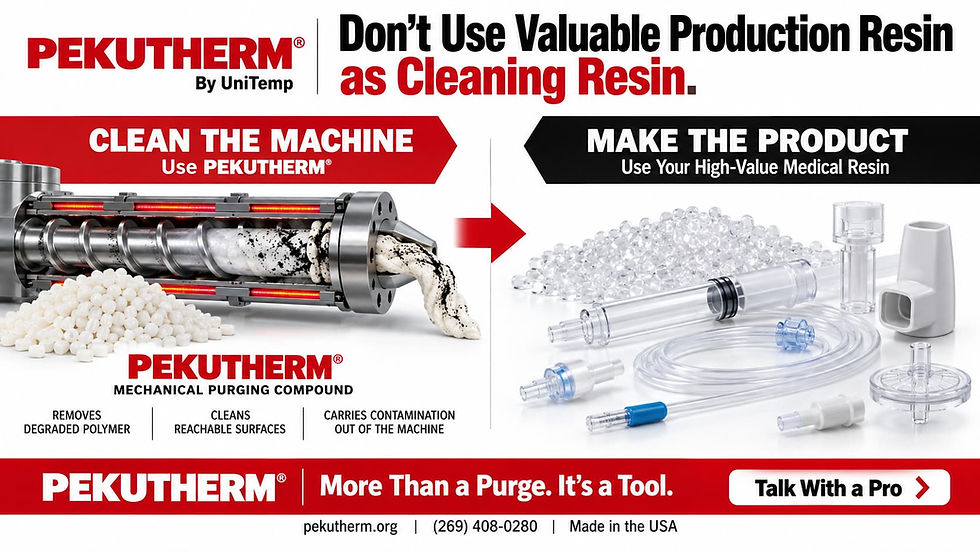
When processors use valuable incoming production resin simply to determine whether a machine is finally clean, that resin becomes part of the cleaning cost instead of the finished product.
PEKUTHERM® gives injection molders and extrusion processors another approach.
It is a mechanical purging compound that uses a self-adhering, thermoelastic soft-scouring action to physically remove degraded polymer, previous material, color contamination and carbon buildup from reachable internal metal surfaces.
No carrier resin.
No chemical reaction.
No abrasive cleaning action.
The objective is straightforward:
Use the purge to clean the machine. Use the production resin to make product.
Running Expensive Medical-Grade Resin?
Use the purge to clean the machine. Use the production resin to make product.
Talk With a Pro: https://www.pekutherm.org/contact-us
Why Medical Plastics Processing Creates a Different Purging Challenge
Medical manufacturing often combines several conditions that make cleaning performance especially important:
High-value polymers
Tight quality requirements
Cleanroom production
Validated processes
High-volume molding or extrusion
Clear, white or light-colored components
High-temperature engineering polymers
Multi-material production
Precision tubing and catheter extrusion
Long production campaigns
Expensive downtime
In these environments, the cost of a purge should not be evaluated only by the price of the purging material.
The more useful question is: How quickly can the machine return to clean, stable, saleable production?
The real changeover or cleaning cost can include:
Purging Compound →
Production Resin Consumed →
Scrap →
Labor →
Machine Downtime
That is particularly important when the production resin itself is expensive.
Medical-Grade Production Resin Should Make Medical Products
Medical processors may work with materials ranging from PE, PP and PVC to TPU, PA, PC and high-performance engineering polymers.
In more demanding applications, processors may also encounter expensive materials such as:
PEEK
PEI
PPS
PPSU
LCP
Other high-performance thermoplastics
Using these materials to continue flushing a machine until contamination finally disappears can become expensive quickly.
PEKUTHERM® allows the processor to separate two jobs:
Cleaning the machine
Use a dedicated mechanical purging compound.
Making the product
Use the validated production resin.
This distinction can become especially valuable when the incoming material carries a high cost per pound or when startup scrap must be tightly controlled.
Cleanroom Production Does Not Automatically Mean a Clean Screw and Barrel
Cleanroom manufacturing controls the production environment.
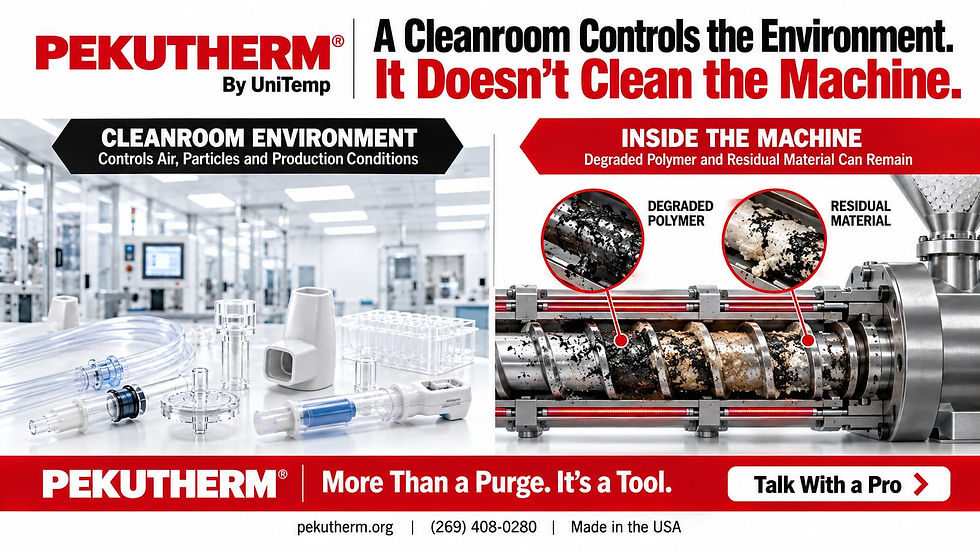
It does not, by itself, remove degraded polymer or residual material from internal processing surfaces.
Inside an injection molding machine or extruder, polymer is still exposed to:
Heat
Pressure
Shear
Residence time
Small amounts of material can remain on internal metal surfaces. Over time, those remnants can degrade, darken or carbonize.
Eventually, retained material may break loose and return to the melt stream.
That can contribute to:
Black specks
Color contamination
Streaking
Startup scrap
Rejected components
Repeated purging
Additional troubleshooting
Production interruptions
That is why equipment cleanliness and environmental cleanliness should be treated as separate issues.
Mechanical Cleaning Instead of Simple Displacement
Moving material through a machine is not necessarily the same as cleaning the machine.
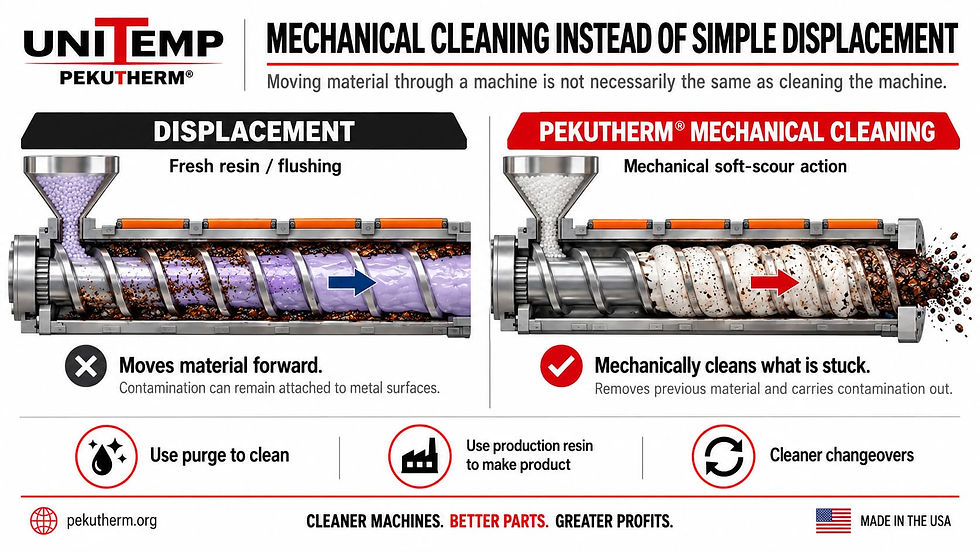
Fresh resin can displace material in the flow path while degraded polymer or contamination remains attached to metal surfaces.
PEKUTHERM® works differently.
During processing, it develops a thermoelastic consistency and self-adheres to the internal geometry of the processing system.
The resulting mechanical soft-scouring action helps physically remove material from reachable metal surfaces and carry that contamination out of the machine.
The principle is:
Displace what is flowing.
Mechanically clean what is stuck.
Medical Injection Molding
Injection molding operations serving medical, pharmaceutical and diagnostic markets may run high production volumes while also requiring consistent part appearance and repeatable process conditions.
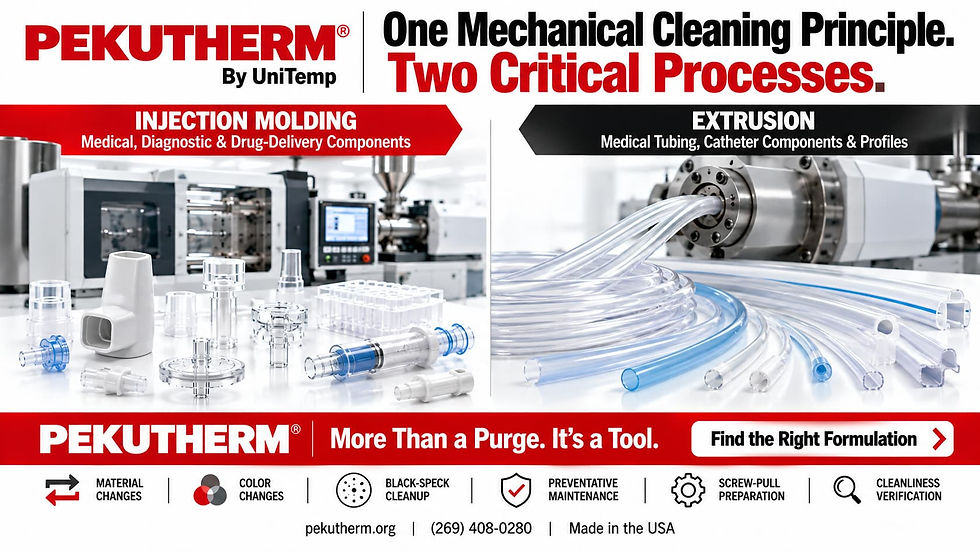
PEKUTHERM® can support operations including:
Material changes
Color changes
Transparent or light-color production
Black-speck cleanup
Preventative maintenance
Screw-pull preparation
Cleanliness verification
High-temperature material processing
For large molding facilities, even relatively small improvements in cleaning time, startup scrap or resin consumption can become meaningful when multiplied across many presses and production campaigns.
Injection Molding or Extrusion?
Tell UniTemp your material, machine size and processing temperature.
Find the Right PEKUTHERM® Formulation
Related PEKUTHERM® content
Material & Color Changeovers
https://www.pekutherm.org/post/post-material-color-changeovers-injection-molding-extrusion-pekutherm
Contamination & Carbon Removal
Medical Tubing & Extrusion
Medical extrusion presents a different set of challenges.
Tubing, catheter components, profiles and specialty extrusions often depend on stable material flow and clean transitions between production runs.
Residual material can contribute to:
Surface defects
Discoloration
Black specks
Contamination
Extended startup
Additional scrap
Repeated flushing
PEKUTHERM® EX, HLT and ULT formulations allow processors to match the mechanical purging approach to the application and processing-temperature range.
The goal remains the same:
Clean the processing system before valuable production material becomes the cleaning material.
High-Temperature Medical Polymers
High-performance medical applications can involve polymers processed at temperatures well above conventional commodity resins.

PEKUTHERM® formulations cover processing temperatures from:
175°F to 752°F
79°C to 400°C
For high-temperature applications, PEKUTHERM® HLT and HLT Fine are designed for processing ranges up to 752°F / 400°C.
That gives processors working with high-temperature engineering plastics a mechanical cleaning option without relying on chemical reactions or carrier-resin dilution.
For these applications, the economics can be particularly compelling because the resin being protected may itself be extremely valuable.
Black Specks and Degraded Polymer
Black specks are often treated as a visible defect.
But the speck itself may only be the symptom.
The source can be degraded polymer or carbonized material remaining inside the processing equipment.
Material can accumulate gradually before breaking loose and appearing in the product.
That is why simply flushing until the specks disappear does not always answer the deeper question:
Has the contamination source actually been removed?
PEKUTHERM® mechanically soft scours reachable surfaces and carries removed contamination out of the processing system.
That helps processors address the buildup rather than only its visible symptoms.
Read more
Preventative Maintenance for Medical Plastics Equipment
Waiting for contamination to appear in production creates a reactive maintenance cycle:
Defect →
Stop →
Troubleshoot →
Clean →
Restart
A preventative approach asks a different question:
When should the machine be cleaned so production never reaches that point?
Scheduled mechanical purging can become part of an existing maintenance program around:
Planned shutdowns
Critical production campaigns
Difficult materials
High-temperature processing
Transparent or light-color production
Known contamination patterns
Recurring black-speck events
Scheduled maintenance
The objective is not unnecessary purging.
It is predictable cleaning.
Read Tool 3
Preparing for a Screw Pull
Sometimes the screw still has to come out.
Before that happens, PEKUTHERM® can be used as a screw-pull aid to mechanically soft scour degraded polymer from reachable metal surfaces.
This can help the maintenance team begin the screw-pull process with cleaner surfaces for inspection and service.
PEKUTHERM® does not work by lubrication or chemical loosening.
The cleaning action remains mechanical.
Read Tool 4
Knowing When the Machine Is Clean
One of the most overlooked uses of a purging compound is cleanliness verification.
A processor experiencing a recurring defect may begin changing:
Temperatures
Material
Screw speed
Process settings
Tooling conditions
Other production variables
But troubleshooting gets harder if one major question remains unanswered:
Is contamination still inside the machine?
PEKUTHERM® helps make the cleaning progression visible as removed material exits with the purge.
A more controlled troubleshooting sequence becomes:
Defect →
Clean →
Verify →
Establish Baseline →
Troubleshoot
PEKUTHERM® does not diagnose the processing problem.
It helps establish a cleaner baseline from which the processor can investigate what remains.
Read Tool 5
PEKUTHERM® Processing Range
PEKUTHERM® provides formulations for injection molding and extrusion across a broad processing-temperature range.
Standard Temperature
375°F–572°F
190°C–300°C
Injection molding formulations include: N • SM • SK
Extrusion: EX
High Temperature
300°F–752°F
149°C–400°C
HLT • HLT Fine
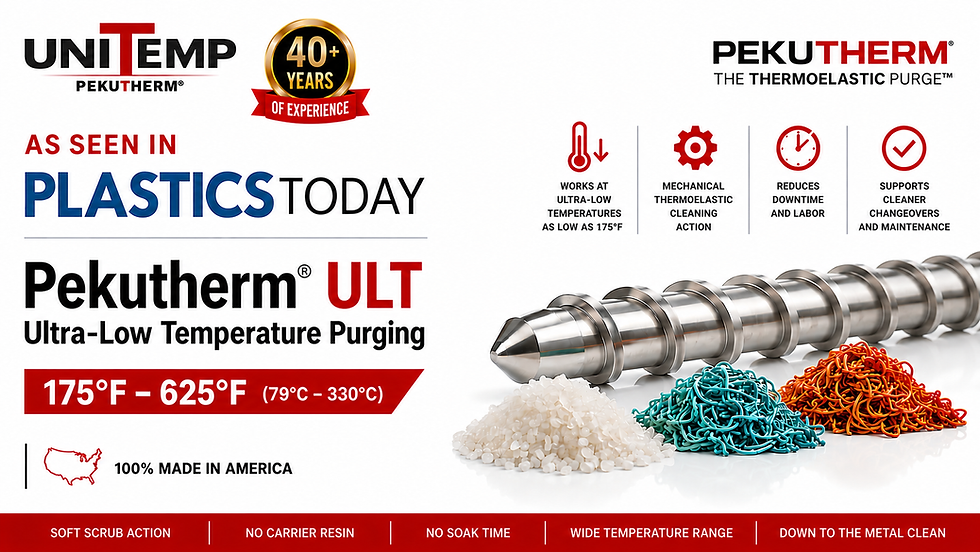
Ultra-Low Temperature
175°F–625 °F
79°C–330°C
ULT • ULT Fine
Formulation selection depends on:
Application Type + Machine Size + Processing Temperature
Where PEKUTHERM® Can Fit in Medical Plastics Production
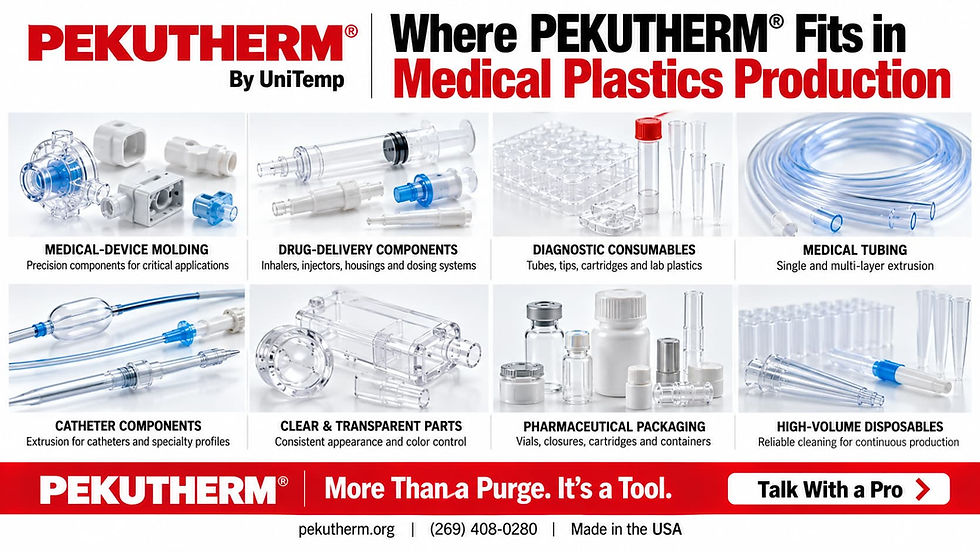
PEKUTHERM® can support processors working in:
Medical-device injection molding
Drug-delivery components
Diagnostic consumables
Laboratory plastics
Medical tubing
Catheter extrusion
Pharmaceutical packaging components
High-temperature medical polymers
Clear and transparent components
Precision molded components
High-volume disposable medical products
The common requirement is not the final product.
It is the need to keep processing equipment clean, transitions controlled and production material focused on making saleable parts.
A Note About Medical Manufacturing Validation
PEKUTHERM® is a processing and equipment-cleaning tool.
It should not be represented as a substitute for a processor’s medical-device, pharmaceutical, cleanroom or regulatory validation requirements.
Each manufacturer remains responsible for determining how cleaning materials and procedures fit within its own:
Quality system
Validation procedures
Equipment requirements
Production controls
Material specifications
Applicable regulatory obligations
PEKUTHERM® should be evaluated within those established procedures just like any other processing material or maintenance practice.
PEKUTHERM® — More Than a Purge. It’s a Tool.
For medical plastics processors, the value of a purging compound is not simply what comes out of the machine.
The larger question is what the cleaning process helps protect:
High-value resin.
Machine time.
Clean production.
Process consistency.
Maintenance time.
PEKUTHERM® brings more than 40 years of mechanical purging experience to injection molding and extrusion applications.
Cleaner Machines. Better Parts. Greater Profits.
Talk With a Pro
Running medical-grade plastics, expensive engineering polymers, cleanroom molding or medical extrusion?
Tell UniTemp:
What material you’re processing
Injection molding or extrusion
Machine size
Processing temperature
Current cleaning or changeover challenge
The team can help determine the appropriate PEKUTHERM® formulation and discuss how to evaluate it in your process. https://www.pekutherm.org/contact-us
Phone: (269) 408-0280
Have a Medical Plastics Cleaning Challenge?
Whether you’re fighting black specks, costly changeovers, high-temperature resin waste, preventative maintenance or recurring contamination, start with the process.
Talk With a PEKUTHERM® Pro https://www.pekutherm.org/contact-us


Comments