
PEKUTHERM® — More Than a Purge. It’s a Tool.

Updated: Aug 19
PEKUTHERM® as a Tool: Purging, Changeovers & Preventive Maintenance
Most plastic processors think of a purging compound in terms of one job: get the old material out so production can start again.
That is certainly part of the job.
But after decades of working with plastic injection molding and extrusion operations, we believe that definition is too narrow.
“It’s a diagnostic tool. Any place where the material hangs up, the purging compound will hang up too.”— Maintenance Manager, North Carolina Injection Molder, independent PEKUTHERM® study, 1995
“A good purging compound shouldn’t simply be something you consume during a changeover. It should be a tool that helps you clean the machine, control contamination, reduce unnecessary scrap, support preventative maintenance, and get production moving again.” Bjorn Krebs, Future Leadership
That is the philosophy behind PEKUTHERM®.
Think Beyond the Flush
The simplest way to purge a machine is to push one material out with another.
The problem is that moving material through a machine and cleaning the machine are not necessarily the same thing.
Degraded polymer, carbon and previous colors can remain on metal surfaces and later break loose, showing up as black specks, streaks or contamination in finished parts.
PEKUTHERM® takes a different approach.
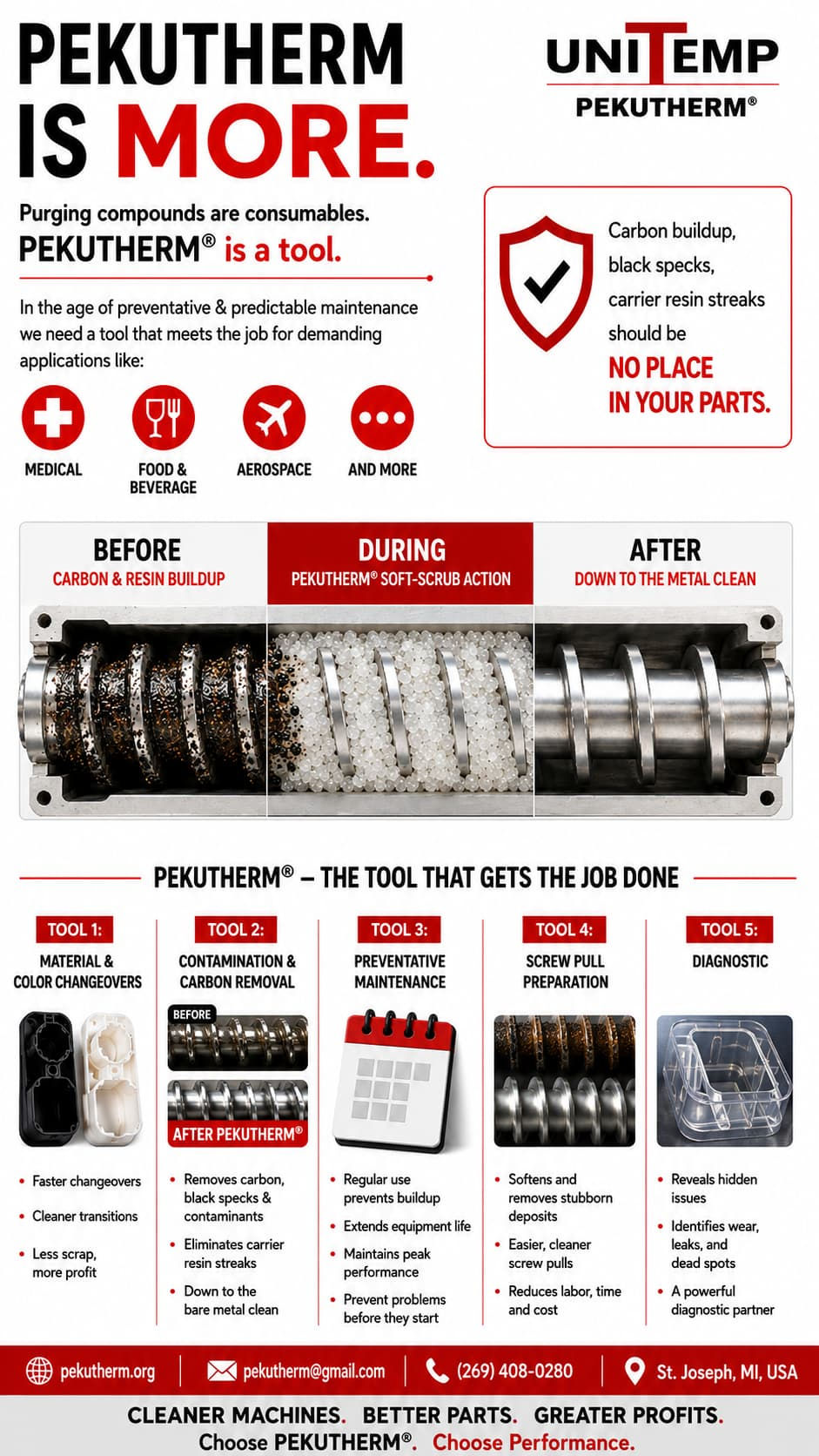
Rather than relying on a carrier resin, chemical reaction, detergent or solvent, PEKUTHERM® uses a physical thermoelastic cleaning action.
During processing, PEKUTHERM® softens to a consistency we often compare to a pencil eraser. The material self-adheres and forms a soft-scouring plug that mechanically works against contaminated metal surfaces as it travels through the machine. Bernd Krebs, President & Chief Executive Officer
That physical action is fundamental to understanding why we consider PEKUTHERM® more than simply a purge.
Tool 1: Material and Color Changeovers
Changing from one resin or color to another creates a basic production problem:
How quickly can you remove the previous material without wasting the material you’re trying to run next?
Processors sometimes use incoming production resin to finish flushing the machine.
That resin costs money. And until the extrudate or molded part is clean, it isn’t production—it is scrap.
PEKUTHERM® is designed to mechanically remove the outgoing material before the incoming material takes over.
No premixing,
soaking or
chemical reaction time is required.
The goal is a cleaner transition with less dependence on valuable incoming resin to determine whether the machine is finally clean.
Tool 2: Contamination and Carbon Removal
Black specks aren’t created at the moment they appear in a finished product. The underlying contamination may have been developing inside the machine long before the operator sees the defect.
Polymers can degrade and accumulate on metal surfaces. Carbon and other residues can remain behind through repeated production cycles. Eventually, pieces can break free and enter the melt stream.
That’s why simply pushing material through the barrel may not solve a recurring contamination problem.
PEKUTHERM’s self-adhering, soft-scouring action is designed to mechanically remove degraded polymer and carbon buildup from metal surfaces and carry that contamination out of the machine.
There is no carrier resin dilution and no chemical reaction involved.
The objective isn’t merely displacement. It’s physical cleaning.
Tool 3: Preventative Maintenance
Purging doesn’t have to begin after something goes wrong.
Used as part of a preventative maintenance strategy, mechanical purging can help processors address contamination before it becomes a production problem.
That distinction matters.
A reactive approach looks like this:
Defect → Stop → Troubleshoot → Clean → Restart
A preventative approach asks a different question:
When should we clean the machine so we don’t reach that point?
Scheduled purging can become another tool in a processor’s maintenance program alongside inspections, cleaning procedures and planned machine service.
The objective is repeatability:
cleaner equipment,
more predictable changeovers and
fewer contamination surprises.
Tool 4: Preparing for a Screw Pull
Sometimes a screw still needs to come out. PEKUTHERM® can help there, too.
As a screw-pull aid, PEKUTHERM® soft-scours degraded polymers from metal surfaces before disassembly. This can enable cleaner and faster screw removal during maintenance while minimizing mechanical wear, labor time and unplanned downtime.
Importantly, PEKUTHERM® is not a lubricant and does not chemically loosen contamination.
The same thermoelastic mechanical action used during normal purging performs the cleaning.
That makes screw-pull preparation another application of the same underlying tool.
Tool 5: Knowing When You’re Clean - a Diagnostic Tool
Use PEKUTHERM® to help determine whether a recurring defect is being caused by contamination inside the machine. By mechanically cleaning the system and confirming cleanliness, processors gain a cleaner baseline for troubleshooting what comes next.
One of the overlooked costs of a purge is the material processors run afterward just to answer a simple question:
Are we clean yet?
If incoming production resin is being used to verify machine cleanliness, every pound used for that purpose is material that isn’t becoming saleable product.
PEKUTHERM® provides a visible transition as contamination is removed and the purge exits the system, helping operators confirm cleanliness without relying on excessive amounts of incoming material to finish the job.
That turns the purge into something more useful than material displacement.
It becomes part of the operator’s cleaning process.
One Tool. Different Processing Challenges.
Injection molding and extrusion equipment vary enormously.
Machine size changes.
Screw geometry changes.
Materials change.
Processing temperatures change.
PEKUTHERM® formulations are selected according to application, machine size and processing temperature, with solutions covering temperatures from 175°F to 752°F (79°C to 400°C).
That range allows the same fundamental mechanical cleaning concept to be applied across conventional thermoplastics, high-temperature engineering resins and ultra-low-temperature applications.
The mechanism remains consistent: Self-adhering. Thermoelastic. Mechanical soft-scouring.
Change the Way You Think About Purging
A purging compound is easy to think of as another production consumable.
Put it in.
Run it through.
Throw it away.
We think processors should expect more.
“When the same material can support changeovers, remove contamination, help control carbon buildup, become part of preventative maintenance, prepare equipment for a screw pull and help verify machine cleanliness, it is performing a much broader role in the operation.” Alizabeth Krebs: Streamlining Operations & Process Development
That’s why we don’t think of PEKUTHERM® as simply something you run through a machine.
Learn more about the 5 types of purging methods
PEKUTHERM® — More Than a Purge. It’s a Tool.
Talk to UniTemp
Not sure which PEKUTHERM® formulation fits your injection molding or extrusion application?
Tell us your application, machine size and processing temperature, and the UniTemp team can help identify the appropriate PEKUTHERM® formulation.
Call today (269) 408-0280 or Contact us here.
Samples are also available for processors who want to evaluate PEKUTHERM® in their own equipment.


Comments