
Five Types of Purging Methods and What Each One Is Designed to Do

Updated: Jul 15
What Types of Purging Methods Are Best? What Do They Do Best?

Not every purging method works the same way. That sounds obvious, but on the production floor, purging products are often compared primarily by brand name, price per pound, or how quickly clean-looking material begins exiting the machine.
The more important question is:
What is the purging method actually designed to do inside the screw and barrel?
Some methods primarily push the previous resin forward. Others rely on lubrication, chemical activity, or a carrier resin.
Pekutherm® uses a fundamentally different approach: a self-adhering, thermoelastic mass that mechanically soft scours contaminated processing surfaces.

Understanding these differences can help injection molders and extrusion processors choose a purging method based on the actual production problem rather than treating every purge as though it performs the same job.
The plastics industry is constantly advancing its understanding of materials, processing and manufacturing technology through organizations such as the Society of Plastics Engineers. UniTemp has been on the cutting edge of our industry for three generations. Bernd Krebs, President & Chief Executive Officer, UniTemp
But purging remains an area where many processors learn primarily through experience on the production floor. That makes understanding the basic categories and mechanisms especially important.
Important: Individual formulations vary by manufacturer, resin, temperature, machine design and application. The categories below describe general operating principles. Always follow the instructions and technical guidance for the specific product being used.
1. Fresh-Resin Flushing
One of the most basic approaches to a material or color changeover is simply running more resin through the machine.
The processor may use virgin resin, regrind or another production material and continue feeding it through the system until the previous material or color is no longer visible.
What fresh-resin flushing is designed to do
Fresh resin is primarily used to:
Displace the previous resin
Push the previous color forward
Transition toward the next production material
Continue flushing until acceptable parts can be produced
This may be adequate for some straightforward changeovers where contamination is minimal and the outgoing and incoming materials are compatible.
However, displacement is not necessarily the same as cleaning.
Fresh production resin does not contain a dedicated mechanical or chemical cleaning mechanism. It may flow through the machine while degraded polymer, carbonized material, color contamination or other residue remains attached to screw flights, barrel walls and other internal surfaces.
The hidden cost of using production resin as the purge
When production resin is used to finish cleaning the machine, processors may consume substantial quantities before acceptable production resumes.
The incoming material may effectively be used to:
Finish flushing the machine
Reveal remaining contamination
Produce startup scrap
Confirm color purity
Determine whether black specks or other defects are still present
That can become especially expensive when processing high-cost engineering polymers.
Running more resin through a machine may move material forward. It does not necessarily remove what is attached to the metal.
The distinction between displacement and deeper cleaning becomes especially important during difficult color changes and material changeovers.
2. Lubricating Purges
Lubricating purge compounds use a fundamentally different mechanism. Rather than relying primarily on a deep mechanical surface-cleaning action, a lubricating purge is designed to reduce friction or change how material moves through the processing system.
What lubricating purges are designed to do
Depending on the formulation, lubricating action may help:
Improve material movement
Reduce adherence between resin and processing surfaces
Move color or material through the machine
Simplify certain changeovers
Reduce the force required to clear material
A lubricating purge may produce a rapid visible improvement because material can move more easily through the system.
But processors should ask another question:
What remains after the lubricating effect is gone?
If degraded polymer or carbonized residue remains attached to internal metal surfaces, contamination may later break loose and reappear as:
Black specks
Color streaks
Burned particles
Surface defects
Intermittent contamination
Lubrication and physical removal are different mechanisms.
A lubricant may help material move. A mechanical cleaning action is intended to physically remove contamination from processing surfaces and carry it out of the machine.
Pekutherm is specifically non-lubricative.
Its cleaning mechanism does not depend on leaving a lubricating film between the production resin and the processing surfaces. Recurring black specks can be an important sign that degraded material remains somewhere within the processing system.
Learn more about the causes of black specks and how they can affect production:
3. Chemical Purging Compounds
Chemical purging compounds rely on chemical activity to help affect, loosen, expand, break down or otherwise interact with residual resin inside the processing system.
Specific chemical purge products can work differently, and their operating instructions may vary significantly.
What chemical purges are designed to do
Depending on the formulation, chemical purging compounds may be designed to:
Affect residual resin through chemical activity
Loosen material in difficult flow areas
Create internal expansion or agitation
Address color or material contamination
Support certain shutdown or sealing procedures
Some chemical purge processes may require
A soaking period
A specific temperature range
A dwell or reaction period
Premixing
A prescribed shutdown or restart procedure
Their performance can depend on the chemistry, resin, processing temperature, machine geometry and type of contamination involved.
Questions processors should ask when evaluating a chemical purge, consider:
Is soaking required?
Is reaction or dwell time required?
What carries the active chemistry through the machine?
How is the purging material cleared?
How does the operator determine when the purge is completely gone?
Does the process physically clean contaminated metal surfaces, chemically affect the residual resin, or combine several mechanisms?
Pekutherm does not rely on chemical reactions, solvents, detergents, soaking periods or reaction time. Its cleaning mechanism is physical and thermoelastic.
That difference is important because chemical purging and mechanical purging are not simply two brands attempting to perform the exact same process in the exact same way.
They are fundamentally different approaches to purging.
4. Carrier-Resin and Hybrid Purges
Many commercial purging compounds use a carrier resin to transport other components through the machine. Depending on the product, the carrier may transport cleaning agents, lubricants, foaming ingredients, particulate materials or other active components.
Some products combine several mechanisms and may be described as hybrid purges.
What carrier-resin purges are designed to do
The carrier resin may be used to:
Deliver active ingredients through the screw and barrel
Provide a processable base material
Move cleaning components into contact with residual resin
Support mechanical, chemical, lubricating or combined cleaning actions
The carrier itself must eventually be displaced before normal production can fully resume.
That creates practical questions for processors:
How much carrier resin must be cleared?
Is the carrier compatible with the incoming production resin?
How will the operator know when it has been completely removed?
Could residual carrier affect clarity, color or early production parts?
How much incoming production material will be required before the system is fully transitioned?
Not every product described as “mechanical” works the same way
This is an important distinction. A purging compound may incorporate some form of physical or mechanical action while still relying on a carrier resin.
Therefore, the word mechanical alone does not necessarily explain the entire composition or operating mechanism.
Processors should ask two separate questions:
Does the product provide a true physical or mechanical cleaning action?
Does the product rely on a carrier resin?
Pekutherm does not use carrier-resin dilution. The Pekutherm material itself forms the self-adhering thermoelastic mass that performs the mechanical soft-scouring action.
5. Pekutherm Thermoelastic Mechanical Purging
Pekutherm represents a distinct approach to mechanical purging.
Rather than depending on a chemical reaction, lubrication or carrier resin, Pekutherm softens into a cohesive, pencil-eraser-like thermoelastic consistency during processing. Alizabeth Krebs, Operations & Process Development, UniTemp
Pekutherm does not operate like a conventional production resin.
As Pekutherm moves through the machine, the material compresses into the available space within the screw flights and barrel, forming a self-adhering thermoelastic plug that conforms to the internal geometry of the processing system.
What thermoelastic mechanical purging is designed to do
Pekutherm is engineered to:
Mechanically soft scour contaminated surfaces
Conform to the screw, barrel and processing flow path
Lift degraded polymer from metal surfaces
Trap color contamination and carbon buildup
Carry removed contamination out with the purge
Help confirm cleanliness before valuable incoming resin is wasted
Support material and color changeovers
Support preventative maintenance
Assist with cleaner screw removal during scheduled maintenance
Its physical action is designed to clean toward the metal surface without relying on abrasive wear.
Pekutherm does not require premixing, soaking or chemical reaction time. It does not rely on carrier resin or a lubricating film.
For processors working with demanding engineering polymers, purging challenges can vary significantly by resin and processing temperature.
Learn more about common purging challenges involving nylon, PET and polycarbonate:
For low-temperature processing applications involving materials such as silicone, EPDM and specialty low-temperature resins, learn more about Pekutherm ULT:
Five Purging Methods. Five Different Mechanisms.
Purging Method | Primary Purpose | Principal Mechanism |
Fresh-resin flushing | Displace the previous production material | Continued material flow |
Lubricating purge | Help material move through or over internal surfaces | Lubrication or reduced friction |
Chemical purge | Chemically affect residual resin | Chemical activity or reaction |
Carrier-resin or hybrid purge | Transport active cleaning components through the machine | Carrier resin combined with one or more mechanisms |
Pekutherm thermoelastic mechanical purge | Physically soft scour, trap and remove contamination | Self-adhering thermoelastic mechanical action |
The right approach depends on the actual problem.
A straightforward color displacement may not require the same cleaning action as:
Recurring black specks
Burned or degraded polymer
High-temperature engineering plastics
Difficult material changes
Extended shutdowns
Preventative maintenance
A scheduled screw pull
The key is understanding what the purge is actually designed to accomplish.
What Does “Clean” Actually Mean?
A machine can appear clean because the previous color is no longer visible.
That does not necessarily mean degraded polymer has been removed from:
Barrel walls
Screw roots
Screw flights
Dead spots
Nozzles
Dies
Downstream tooling
A more meaningful definition of clean considers:
Whether contamination has been removed from processing surfaces
Whether black specks return after production resumes
Whether the incoming resin remains uncontaminated
How much startup material must be discarded
Whether the next screw pull reveals substantial hidden buildup
This is why a purging method should be evaluated by more than the appearance of the material exiting the machine at one moment.
The machine may look clean before the machine is actually clean.
Purging Is Also a Preventative Maintenance Strategy
Purging is not limited to emergency contamination problems or color changes.
A planned preventative purging program may help processors manage degraded material before buildup contributes to:
Recurring black specks
Increased scrap
Longer changeovers
Unplanned cleaning
Difficult screw pulls
Additional maintenance downtime
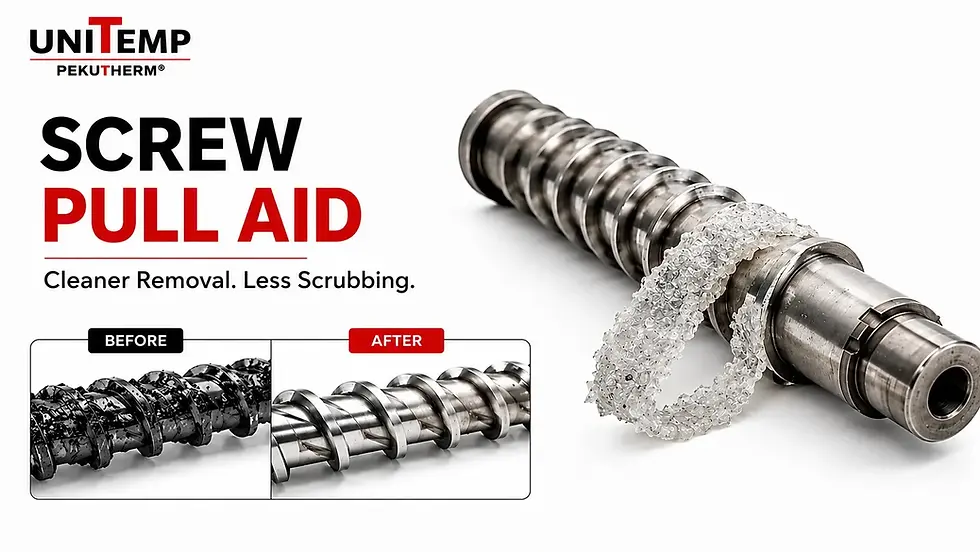
Pekutherm can also be used as a screw pull aid.
Before the screw is removed, its thermoelastic soft-scouring action helps remove degraded polymer from metal surfaces. This can support cleaner screw removal and reduce the amount of manual cleaning required during maintenance.
Learn more about the relationship between preventative purging and screw pulls:
How Should a Processor Evaluate a Purging Method?
Price per pound does not provide a complete comparison.
A proper production trial should measure the entire changeover or maintenance event. Track:
Total purge quantity
Total purge time
Incoming production resin consumed
Startup scrap
Time until acceptable parts are produced
Labor required
Black-speck recurrence
Color-streak recurrence
Material discovered during the next screw pull
Frequency of unplanned cleaning
Total machine downtime
A lower-cost material can become an expensive purge if it requires more pounds, more labor, more production resin or a longer production interruption.
The better question is not simply:
How much does the purging compound cost per pound?
The more useful question is:
What does the complete changeover cost from the final good part of one production run to the first good part of the next?
One Machine. Different Purging Mechanisms. Different Results.
Purging methods are not interchangeable.
Fresh resin primarily displaces material.
Lubricating compounds are designed to alter how material moves through the system.
Chemical systems rely on chemical activity.
Carrier-resin compounds use a processable base to transport other components through the machine.
Pekutherm uses a carrier-resin-free, non-chemical, non-lubricative thermoelastic mechanical action designed to physically soft scour contaminated processing surfaces. Björn Krebs, Future Leadership, UniTemp
Before selecting a purging method, ask:
What is this product actually designed to do inside my machine?
That answer may explain why two products both called “purging compounds” can produce very different results.
Prove It on Your Own Machines
Every processing application is different. UniTemp can help identify the appropriate Pekutherm formulation based on:
Injection molding or extrusion
Machine size
Processing temperature
Resin or material
Changeover challenge
Maintenance objective
Test Pekutherm under your actual operating conditions and compare the complete result:
Purge time. Material consumption. Scrap. Labor. Cleanliness. Production restart.
Phone: (269) 408-0280
Black Specks
Preventative Purging and Screw Pulls
Common Purging Challenges: Nylon, PET and Polycarbonate
Pekutherm ULT: Ultra-Low-Temperature Purging


Comments