
Common Purging Challenges When Processing Nylon, PET & Polycarbonate (2026 Guide)

Plastic processors working with engineering-grade resins such as Nylon (PA), Polyethylene Terephthalate (PET), and Polycarbonate (PC) face unique production challenges.
“These materials are widely used because of their strength, durability, dimensional stability, and performance characteristics. However, they can also create significant cleaning and changeover difficulties inside injection molding and extrusion equipment.” Bernd Krebs President & Chief Executive Officer
When purge procedures are ineffective, processors often experience longer downtime, increased scrap rates, color contamination, carbon buildup, and inconsistent startup conditions.
Understanding the most common purging challenges associated with Nylon, PET, and Polycarbonate can help processors maintain cleaner equipment, reduce downtime, and improve overall production efficiency.
Why Engineering Resins Are More Difficult to Purge
Engineering polymers often process at higher temperatures than commodity materials.
Higher temperatures increase the likelihood of:
Polymer degradation
Carbon formation
Black specks
Material hang-up points
Color contamination
Burned resin buildup
As processing temperatures increase, residual material remaining inside the screw, barrel, non-return valve, dead spots, and hot runner systems becomes more difficult to remove.
Over time, these residues can contribute to recurring contamination issues that continue to appear long after a production run has ended.
Challenge 1: Carbon Buildup
Carbon contamination remains one of the most common causes of quality issues during engineering resin processing.

As materials remain exposed to elevated temperatures, small amounts of degraded polymer can accumulate on metal surfaces.
Eventually, those deposits break free and appear as:
Black specks
Burn marks
Surface defects
Cosmetic imperfection
These defects often result in:
Increased scrap
Customer quality concerns
Additional troubleshooting time
Unplanned maintenance events
Routine purging and preventative maintenance can help minimize carbon accumulation before it impacts production.
Challenge 2: Color Changeovers
Nylon, PET, and Polycarbonate frequently require color transitions that can become time-consuming and expensive.
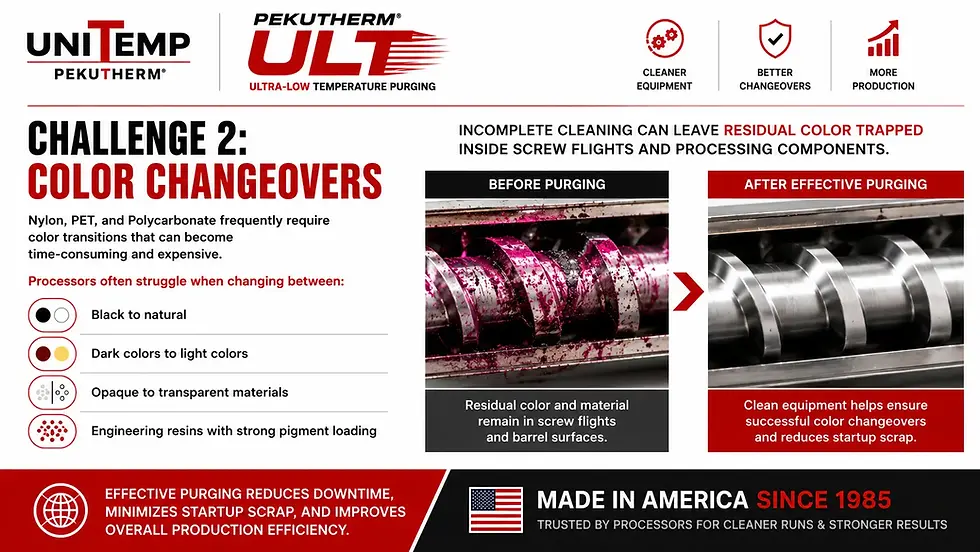
Processors often struggle when changing between:
Black to natural
Dark colors to light colors
Opaque to transparent materials
Engineering resins with strong pigment loading
Incomplete cleaning can leave residual color trapped inside screw flights and processing components.
The result is:
Excessive purge consumption
Extended machine downtime
Startup scrap
Delayed production schedules
Effective mechanical purging helps reduce residual contamination while confirming machine cleanliness before production resumes.
Challenge 3: Material Changeovers
Switching between engineering materials presents additional challenges beyond color removal.
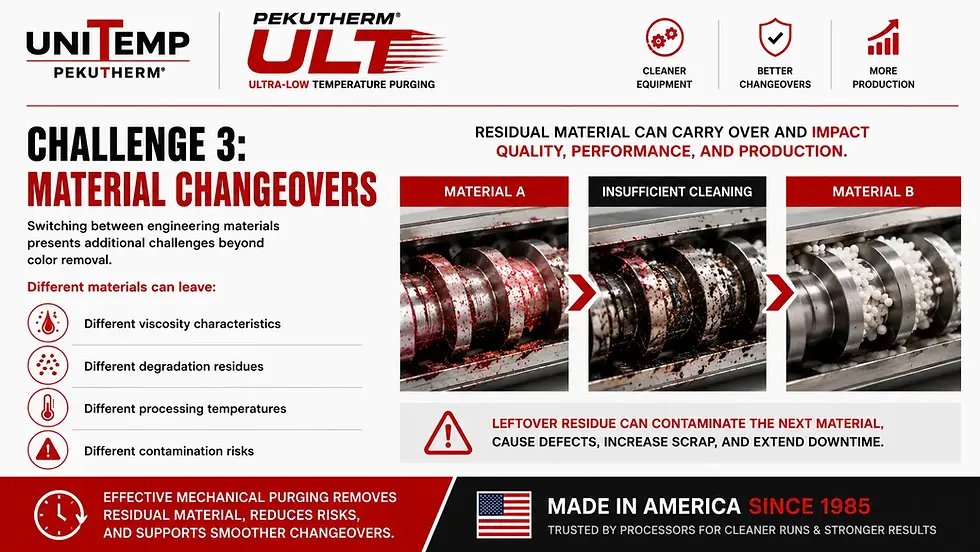
Different materials can leave:
Different viscosity characteristics
Different degradation residues
Different processing temperatures
Different contamination risks
For example:
Nylon may leave moisture-sensitive residues.
PET often requires careful attention to contamination and degradation control.
Polycarbonate can create stubborn deposits if exposed to excessive heat for prolonged periods.
Without effective cleaning, residual material can carry over into subsequent production runs.
Challenge 4: Extended Downtime
Many processors underestimate the true cost of prolonged purge procedures.
Downtime affects:
Production schedules
Labor utilization
Machine availability
Customer delivery timelines
Plant profitability

When machines remain offline during lengthy cleaning cycles, the cost often extends far beyond the purge material itself.
Reducing downtime while maintaining cleanliness remains one of the primary goals of modern purging programs.
Challenge 5: Startup Scrap
One of the largest hidden costs in plastics processing occurs after a changeover appears complete.

Many processors continue running incoming material simply to verify cleanliness.
This can generate:
Excess startup scrap
Material waste
Additional machine time
Delayed production starts
Mechanical purging compounds help verify machine cleanliness before valuable production materials are introduced.
This reduces waste while improving startup confidence.
The Role of Mechanical Purging
Mechanical purging compounds work differently than systems that rely primarily on chemical reactions or carrier-resin dilution.
PEKUTHERM® uses a thermoelastic mechanical action that:
Soft-scours degraded material
Removes residual contamination
Helps clean polished metal surfaces
Supports material and color changeovers
Assists preventative maintenance workflows
“Because the purge creates a self-adhering thermoelastic cleaning plug, it helps physically remove contamination from processing equipment without relying on soaking procedures or chemical reactions.” Björn Krebs Future Leadership
Preventative Maintenance Matters
Many contamination problems develop gradually over time.
Waiting until defects appear often means:
More downtime
More scrap
More labor
More maintenance
Preventative maintenance purges help processors:
Reduce carbon buildup
Improve machine cleanliness
Support consistent production
Reduce emergency shutdowns
Improve overall process stability
For Nylon, PET, and Polycarbonate processors, preventative maintenance often becomes one of the most cost-effective tools available for maintaining production efficiency.
Why Processors Choose PEKUTHERM®
PEKUTHERM® mechanical purging compounds are used throughout injection molding and extrusion operations to support:
Color changeovers
Material transitions
Carbon removal
Preventative maintenance
Startup quality control
Production consistency
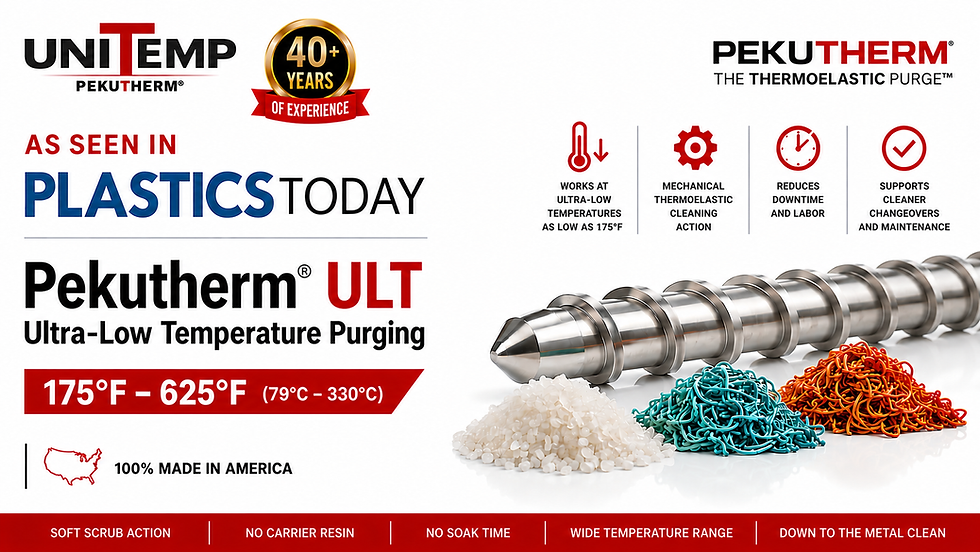
PEKUTHERM® products operate across processing temperatures ranging from: 175°F – 752°F(79°C – 400°C)
This allows processors to select the appropriate formulation based on:
Processing temperature
Machine size
Application requirements
Made in America Since 1985
PEKUTHERM® has been trusted in continuous production use since 1985.
Today, processors across injection molding and extrusion operations rely on PEKUTHERM® mechanical purging compounds to reduce downtime, improve changeovers, and maintain cleaner production equipment.
Contact Us: https://www.pekutherm.org/contact-us
FAQ
Why is Nylon difficult to purge?
Nylon processes at elevated temperatures and can leave residues that become difficult to remove if allowed to degrade on metal surfaces.
Why does PET create black specks?
PET can degrade when exposed to excessive heat or residence time, contributing to carbon formation and contamination.
Is Polycarbonate difficult to clean from processing equipment?
Polycarbonate can leave stubborn deposits when exposed to prolonged heat, making effective purging important during changeovers.
What causes startup scrap after a material change?
Residual contamination, color carryover, and incomplete cleaning often contribute to startup scrap following changeovers.
What is a mechanical purging compound?
A mechanical purging compound uses physical cleaning action to remove contamination rather than relying primarily on chemical reactions.


Comments