
PEKUTHERM® SK vs. SM: Choosing the Right Purging Compound for Injection Molding

Updated: 2 days ago
What are the best small and medium purging compounds? When it comes to mechanical purging, the right granule size makes a difference.
Podcast Video: PEKUTHERM® SK vs. SM Explained
In this edition of PEKUTHERM’s Plastic Podcast, UniTemp breaks down the difference between SK and SM and how each supports mechanical purging in small to medium injection molding machines.
Listen to the 5-minute explainer below to see how PEKUTHERM® forms a thermoelastic plug, mechanically removes retained contamination, and helps move dirty material out of the screw and barrel.
Not all injection molding machines are built alike, and not every purging compound is suited to every machine.
A 50-ton injection molding press and a 120-ton production machine may process similar polymers, but their injection units can have different screw diameters, feed geometries, and material-handling requirements.
Those differences matter when selecting a mechanical purging compound.
PEKUTHERM® SK (Small) and SM (Medium) are two specialized formulations designed for different injection molding machine-size categories.
Both use the same self-adhering, thermoelastic mechanical-cleaning principle. Both operate within the same standard processing-temperature range.
The primary difference is granulation and intended equipment size.
Understanding that distinction helps plastics processors select the appropriate PEKUTHERM formulation for color changes, material transitions, and equipment cleaning.
PEKUTHERM SK vs. SM: What’s the Difference?
PEKUTHERM offers standard-temperature mechanical purging formulations suited to different injection molding machine classifications.
Feature | PEKUTHERM SK | PEKUTHERM SM |
Granulation | Small | Medium |
Machine size | 80 tons or smaller | 80–150 tons |
Processing temperature | 375°F–572°F | 375°F–572°F |
Cleaning mechanism | Thermoelastic mechanical action | Thermoelastic mechanical action |
Primary applications | Small injection molding machines | Mid-size injection molding machines |
Both formulations operate from 375°F–572°F (190°C–300°C).
These machine-size classifications provide an initial selection guide. Actual compatibility also depends on injection-unit geometry, processing conditions, and the material being processed.
For equipment near the 80-ton classification boundary, UniTemp can help confirm the appropriate formulation.

PEKUTHERM SK: Small Granulation for Smaller Injection Molding Machines
Smaller injection molding machines often have limited processing volumes and more restrictive feed geometries.
Their screw channels and feed sections may require purging material with appropriately sized granules.
PEKUTHERM SK is designed for injection molding machines rated at 80 tons or smaller.
Its small granulation provides a formulation option for equipment where larger granules may be less suitable for feeding and conveying.
Typical applications for appropriately matched equipment include:
Routine material changeovers.
Color changes between production runs.
Removal of residual polymer.
Mechanical cleaning of degraded material deposits.
Cleaning associated with scheduled maintenance.
SK can be considered for smaller production machines and compatible specialized injection molding equipment.
However, small granulation alone does not establish compatibility with every miniature or micro-molding machine. Unusual processing configurations require individual evaluation.

PEKUTHERM SM: Medium Granulation for Mid-Size Injection Molding Machines
For larger injection units within the standard-temperature processing category, PEKUTHERM SM provides another granulation option.
PEKUTHERM SM is designed for injection molding machines rated at 80–150 tons.
SM uses medium granulation while maintaining the same fundamental mechanical-cleaning process as SK.
Its intended applications include:
Material and color changeovers.
Removal of retained production polymers.
Cleaning degraded polymer deposits.
Addressing carbonaceous contamination.
Supporting regular machine-cleaning procedures.
Both use PEKUTHERM’s thermoelastic mechanical action.
The important question is which formulation is appropriate for the equipment.
Why Granulation Matters Beyond Machine Tonnage
Clamping tonnage is a useful starting point when selecting a purging compound, but it does not fully describe the injection unit.
Two machines with similar clamping capacities may have different screw diameters, shot capacities, feed arrangements, and processing geometries.
These characteristics can influence how effectively purging material enters and advances through the equipment.
Consider three common selection scenarios.
Example 1: A 50-Ton Injection Molding Machine
A plastics processor operates a 50-ton machine at 450°F.
The operation requires cleaning between two production colors.
PEKUTHERM SK is the starting formulation to evaluate because the machine falls within its intended size classification and the processing temperature is within the standard range.
Final selection should confirm the actual injection-unit configuration and applicable purging instructions.
Example 2: A 120-Ton Production Machine
A manufacturer operates a 120-ton injection molding press at 500°F.
The operation requires a material changeover with residual polymer remaining from the previous production run.
PEKUTHERM SM is the starting formulation to evaluate.
Its medium granulation is intended for this machine-size category, and the operating temperature falls within the established standard range.
Example 3: A Small Machine Processing at 650°F
A processor operates a small injection molding machine at 650°F.
Although the equipment is small, the operating temperature exceeds the standard-temperature range of SK and SM.
Neither should be selected based on machine size alone.
A high-temperature PEKUTHERM formulation, such as HLT or HLT Fine, should instead be evaluated for the specific equipment and application.
The lesson: Machine size matters, but processing temperature and equipment compatibility must also be considered.
These examples illustrate formulation-selection logic.

How Do SK and SM Mechanically Remove Contamination?
PEKUTHERM uses a physical cleaning mechanism that differs from conventional resin flushing.
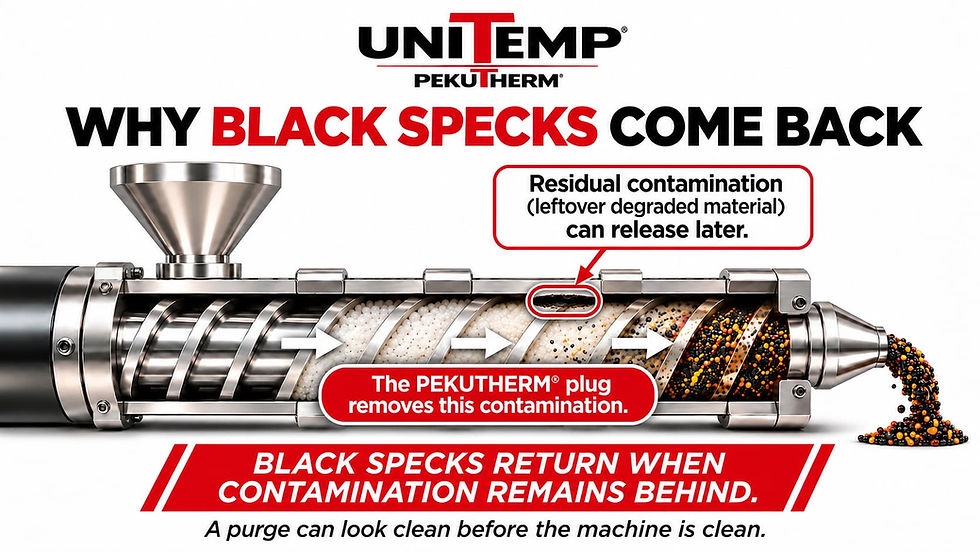
During processing, PEKUTHERM develops a resilient, thermoelastic consistency and forms a self-adhering cleaning plug.
This material mechanically soft-scours accessible screw and barrel surfaces, helping remove:
Residual polymers from previous production runs.
Color contamination.
Degraded polymer deposits.
Carbonaceous contamination and associated residues.
The purging material carries removed contamination forward for discharge from the equipment.
PEKUTHERM does not swell or expand.
Its mechanical-cleaning action does not rely on blowing agents, chemical foaming, or volumetric expansion.
Both SK and SM use this same fundamental cleaning principle.
Their granulation differences help address different equipment requirements.
What About Other PEKUTHERM Formulations?
SK and SM are part of a broader family of mechanical purging compounds serving injection molding and extrusion equipment.
For standard-temperature injection molding machines larger than the SM classification, PEKUTHERM N provides another formulation option.
High-temperature and ultra-low-temperature applications may require different products.
PEKUTHERM Processing Temperature & Formulation Guide
Temperature Category | Processing Range | Formulations |
Standard Temperature | 375°F–572°F (190°C–300°C) | Injection: N, SM, SK; Extrusion: EX |
High Temperature | 300°F–752°F (149°C–400°C) | HLT, HLT Fine |
Ultra-Low Temperature | 175°F–625°F (79°C–330°C) | ULT, ULT Fine |
These processing ranges identify formulation compatibility, not recommended machine-temperature setpoints.
HLT Fine and ULT Fine offer fine-granulation options for applications requiring their respective temperature compatibility.
However, selecting a Fine formulation is not automatically the correct answer for every small machine.
The complete processing application must be considered.
Five Questions to Ask Before Choosing SK or SM
Before selecting a PEKUTHERM formulation, a processor should establish the following equipment and production details.
1. What is the machine’s clamping tonnage?
This provides an initial indication of whether SK or SM may be appropriate.
2. What is the screw diameter?
Screw geometry and feed characteristics can influence how granules are conveyed through the injection unit.
3. What material and temperature are being processed?
Confirm the outgoing and incoming polymers, relevant additives, and actual processing temperatures.
4. What cleaning problem are you trying to solve?
A routine color change may present different cleaning challenges from retained degraded polymer or recurring black-speck contamination.
5. Does the machine have special processing components?
Specialized injection-unit configurations and restrictive processing geometries may require additional technical evaluation.
Always follow the appropriate PEKUTHERM operating instructions and consult UniTemp when equipment compatibility is uncertain.
When these five details are available, UniTemp can help identify the appropriate formulation and procedure.
Why Selecting the Right Formulation Matters
An effective purging procedure begins before the material enters the hopper.
It starts with selecting a formulation suited to the machine and application.
When the formulation is properly matched to the equipment, mechanical purging can help processors:
Remove residual material during changeovers.
Address retained degraded polymers and contamination.
Reduce unnecessary use of incoming production resin for flushing.
Support more consistent equipment-cleaning procedures.
Establish a cleaner processing baseline before production resumes.
Actual performance depends on equipment condition, processing materials, contamination level, and operating procedure.
The objective is not simply to purge faster. It is to establish an appropriate, repeatable cleaning process.
Frequently Asked Questions
What is the difference between PEKUTHERM SK and SM?
The primary difference is granulation and intended injection molding machine-size classification.
SK uses small granulation for machines rated at 80 tons or smaller. SM uses medium granulation for machines rated at 80–150 tons.
Both share the same standard-temperature range and thermoelastic mechanical-cleaning principle.
Do SK and SM have different processing temperatures?
No. Both operate within 375°F–572°F (190°C–300°C).
Can PEKUTHERM SK be used in a 100-ton injection molding machine?
A 100-ton machine falls within the general SM size classification.
However, final formulation selection should consider the actual injection unit and processing requirements rather than tonnage alone.
Which formulation should be used for an 80-ton machine?
The published machine-size classifications meet at 80 tons.
UniTemp should confirm the appropriate formulation based on the specific machine’s injection-unit configuration and processing conditions.
Does PEKUTHERM use chemical reactions to remove contamination?
No. PEKUTHERM uses a self-adhering thermoelastic mechanical-cleaning process to help remove residual polymers and contamination.
It does not rely on swelling, expansion, or blowing agents.
Can SK and SM help address black specks?
Both are intended to help mechanically remove degraded polymer deposits and carbonaceous contamination from compatible processing equipment.
However, recurring black specks can have several causes, including retained material, excessive residence time, and contaminated feedstock.
Purging addresses removable contamination; the underlying source must also be identified.
The Right Purging Compound Starts With the Right Machine
PEKUTHERM SK and SM share the same fundamental mechanical-cleaning action.
Their differences reflect a practical reality of plastics processing: different machines require appropriately matched purging materials.
SK provides small granulation for smaller injection molding machines.
SM provides medium granulation for mid-size injection molding machines.
Both operate within the standard PEKUTHERM temperature range of 375°F–572°F.
The correct selection depends on machine size, injection-unit configuration, processing temperature, and the specific cleaning challenge.
Need Help Choosing Between PEKUTHERM SK and SM?
Tell us about your injection molding machine, the materials you’re running, and the contamination or changeover challenge you’re trying to solve.
Our team can help evaluate the appropriate PEKUTHERM formulation and discuss technical guidance or product samples.
Real People. Real Processing Challenges. Practical Solutions.
UniTemp | PEKUTHERM®Family-Owned. American-Made. Serving Plastics Processors Since 1985.
Phone: (269) 408-0280
Address: 1043 E. John Beers Road, St. Joseph, MI 49085 Website: https://www.pekutherm.org


Comments