
Purging Small Injection Molding Machines: Why Granule Size Matters

Updated: 2 hours ago
Small machines. Tight processing geometries. The right mechanical purging compound starts with the right formulation.
Episode: Purging Small Injection Molding Machines — Why Granule Size Matters
Prefer to listen? We’ve put together a short podcast exploring how granule size, machine geometry, and processing temperature affect mechanical purging.
🎧 Listen to Our Latest PEKUTHERM® Podcast: Like Share. Subscribe.

Small injection molding machines present unique challenges during material changes, color changeovers, and equipment cleaning.
Unlike larger production machines, smaller injection units often have narrower screw channels, reduced processing volumes, and more restrictive feed geometries. These characteristics can influence how purging materials enter and move through the equipment.
That’s why granule size matters.
PEKUTHERM® mechanical purging compounds are available in specialized formulations for different equipment sizes and processing temperatures.
Choosing the appropriate formulation helps ensure the material can be introduced, conveyed, and used effectively during the cleaning process.
For small injection molding machines, matching the purging compound to the equipment is just as important as matching it to the processing temperature.
Why Granule Size Matters in Small Injection Molding Machines
Before a purging compound can clean a machine, it must enter the feed section and move through the screw and barrel assembly.
During injection molding, material enters through the hopper and is conveyed along the rotating screw inside the heated barrel.
The dimensions and configuration of these components influence material movement.
Smaller injection molding machines may have:
Smaller screw diameters.
Narrower screw channels.
More restrictive feed-section geometries.
Lower material-processing volumes.
Specialized injection-unit configurations.
These characteristics become especially important when selecting a mechanical purging compound.
Granules appropriate for a large production machine may not feed or convey as intended in a smaller injection unit.
The correct granule size supports consistent material feeding and the mechanical cleaning process.
Rather than relying on one formulation for every application, PEKUTHERM offers different granulation options to accommodate varying processing requirements.
How PEKUTHERM Mechanical Purging Works
PEKUTHERM uses a physical, thermoelastic mechanical-cleaning mechanism.
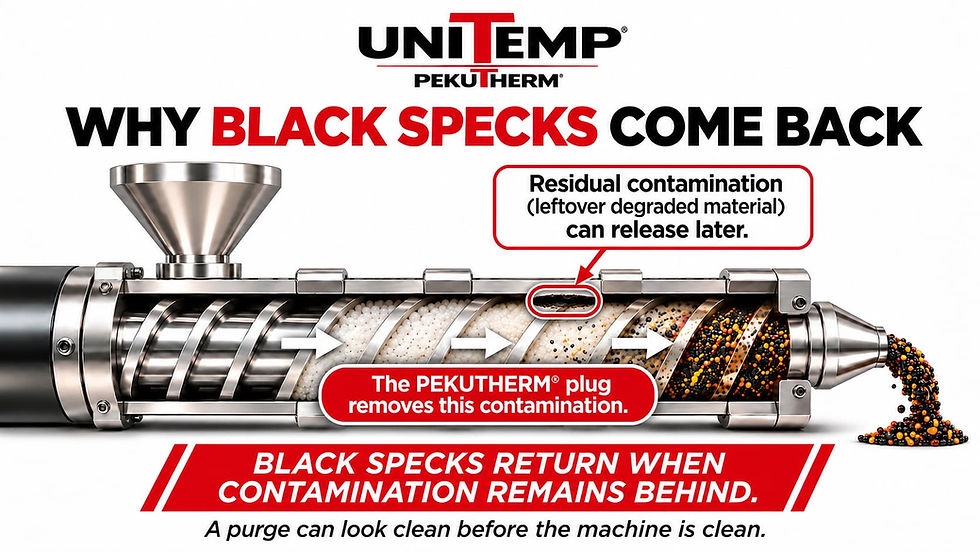
As PEKUTHERM granules move through heated processing equipment, they develop a resilient, pencil-eraser-like thermoelastic consistency and form a self-adhering cleaning plug.
This material mechanically soft-scours accessible internal processing surfaces, helping remove:
Residual production polymers.
Degraded polymer deposits.
Color contamination.
Carbonaceous residue and associated contamination.
The purging material carries removed contamination out of the processing equipment.
Unlike conventional resin flushing, PEKUTHERM does not rely primarily on diluting residual material with additional production resin.
PEKUTHERM does not swell or expand inside the barrel.
Its cleaning action does not depend on blowing agents, chemical foaming, or volumetric expansion.
Instead, PEKUTHERM uses its self-adhering thermoelastic properties to mechanically remove residual materials and contamination.
This distinction is important when understanding how the compound performs inside smaller screw channels and processing geometries.
PEKUTHERM SK, SM, and N: Matching Formulation to Machine Size
PEKUTHERM offers three standard-temperature formulations for injection molding equipment:
PEKUTHERM SK: Smaller injection molding machines.
PEKUTHERM SM: Mid-size injection molding machines.
PEKUTHERM N: Larger injection molding machines.
PEKUTHERM SK, SM, and N are designed for standard-temperature injection molding applications, with a processing range of 375°F–572°F (190°C–300°C).
Although these formulations share the same processing-temperature range, their intended machine-size applications and granulation characteristics differ.
Standard-Temperature Injection Molding Formulations
PEKUTHERM Formulation | Machine Size | Processing Temperature |
SK | 80 tons or smaller | 375°F–572°F (190°C–300°C) |
SM | 80–150 tons | 375°F–572°F (190°C–300°C) |
N | 150 tons or larger | 375°F–572°F (190°C–300°C) |
Machine-size categories provide a starting point for formulation selection. Actual equipment geometry, operating conditions, and application requirements must also be considered.

PEKUTHERM SK: Small Injection Molding Machines
PEKUTHERM SK is designed for smaller injection molding machines operating within the standard-temperature range.
Its granulation is intended to accommodate the feeding and conveying requirements associated with appropriately matched small-machine applications.
These may include smaller production presses, precision molding operations, and specialized processing environments.
For equipment with unusually small injection units or nonstandard screw geometries, compatibility should be confirmed before use.
PEKUTHERM SM: Mid-Size Injection Molding Machines
PEKUTHERM SM serves the 80–150-ton injection molding machine category.
It uses the same underlying thermoelastic mechanical-cleaning principle as SK, with granulation suited to its intended equipment classification.
SM provides a formulation option for processors operating mid-size injection molding machines within the standard-temperature range.
PEKUTHERM N: Larger Injection Molding Machines
PEKUTHERM N is designed for injection molding machines rated at 150 tons or larger.
It provides mechanical purging for larger processing systems operating within the same standard-temperature range.
The appropriate formulation should always be selected with consideration for the actual injection unit and processing conditions.
Why Machine Tonnage Alone Doesn’t Tell the Whole Story
Clamping tonnage is a convenient way to classify injection molding equipment.
However, two machines with similar tonnage ratings can have very different processing configurations.
Important differences may include:
Screw diameter.
Feed-section dimensions.
Screw-channel geometry.
Injection capacity.
Nozzle configuration.
Processing temperature.
Material characteristics.
These factors affect how purging materials enter, move through, and exit the equipment.
For example, a smaller injection unit may have feeding requirements that differ from another machine within the same tonnage category.
This is why PEKUTHERM formulation selection should account for the machine’s actual processing configuration rather than relying exclusively on clamping force.
High-Temperature and Ultra-Low-Temperature Applications
Not every small injection molding machine operates within the standard-temperature range.
Some applications involve high-temperature engineering polymers, while others process materials at substantially lower temperatures.
PEKUTHERM provides additional formulations to address these different conditions.
PEKUTHERM Processing Temperature & Formulation Guide
Temperature Category | Processing Range | PEKUTHERM Formulations |
Standard Temperature | 375°F–572°F (190°C–300°C) | Injection Molding: N, SM, SK; Extrusion: EX |
High Temperature | 300°F–752°F (149°C–400°C) | HLT, HLT Fine |
Ultra-Low Temperature | 175°F–625°F (79°C–330°C) | ULT, ULT Fine |
These ranges describe PEKUTHERM formulation operating compatibility, not recommended machine-temperature settings.
PEKUTHERM HLT Fine
PEKUTHERM HLT Fine offers a fine-granule option within the high-temperature formulation family.
It operates within the 300°F–752°F (149°C–400°C) processing range.
The formulation may be considered for applications requiring high-temperature compatibility and appropriate fine-granule characteristics.
Suitability depends on the machine configuration, processing material, and operating conditions.
PEKUTHERM ULT Fine
PEKUTHERM ULT Fine provides a fine-granule option within the ultra-low-temperature formulation family.
It operates within the 175°F–625°F (79°C–330°C) processing range.
This formulation supports applications requiring the corresponding temperature compatibility and granulation characteristics.
HLT Fine and ULT Fine are not interchangeable simply because both feature fine granulation.
The correct choice depends on the application and operating temperature.

Small Injection Molding Machines in Precision Manufacturing and Laboratories
Small injection molding equipment is used across many manufacturing and research environments.
These operations often process relatively small material volumes, perform frequent changeovers, or require careful contamination control.
Precision Plastic Manufacturing
Precision molding operations may use smaller injection units to manufacture specialized components.
Residual material from previous production runs can affect subsequent processing, particularly during color or material changes.
Selecting an appropriate mechanical purging compound can help address contamination without relying solely on flushing the equipment with additional production resin.
Materials Testing Laboratories
Materials laboratories frequently evaluate different polymers, additives, and experimental formulations.
When several materials are processed using the same equipment, residual contamination can influence later trials.
Effective cleaning procedures help reduce this potential source of variability.
Research and Development
R&D departments may perform short production runs while developing new components, evaluating polymer formulations, or testing manufacturing processes.
Frequent material changes make repeatable cleaning procedures especially valuable.
Specialized and Micro-Molding Equipment
Specialized injection molding equipment may have unusually small feed systems, screw geometries, or processing pathways.
These applications require individual compatibility evaluations.
A fine-granule formulation should not automatically be considered compatible with every micro-molding machine.
What Happens When Granule Size Is Not Appropriate?
The physical characteristics of a purging compound influence how it feeds and moves through processing equipment.
When granulation is poorly matched to the injection unit, operators may encounter:
Irregular material feeding.
Restricted movement through the feed section.
Inconsistent conveying behavior.
Difficulty establishing the intended mechanical-cleaning process.
These considerations are particularly relevant in smaller equipment with more restrictive processing geometries.
However, granule size is only one part of successful formulation selection.
Temperature compatibility, screw design, equipment configuration, and the specific cleaning objective must also be considered.
The goal is not to select the smallest granules available. It is to select the right PEKUTHERM formulation for the machine and application.
Five Factors to Consider Before Selecting a Purging Compound
Choosing the appropriate mechanical purging compound begins with understanding the equipment and production requirements.
1. Machine Size and Screw Geometry
Identify the injection molding machine manufacturer, model, clamping tonnage, and screw diameter.
Where available, review relevant injection-unit and feed-section specifications.
2. Processing Temperature
Confirm that the machine’s operating conditions are compatible with the intended PEKUTHERM formulation.
SK, SM, and N operate within the standard-temperature range of 375°F–572°F.
Applications requiring other temperature ranges may call for a different PEKUTHERM formulation.
3. Materials Being Processed
Identify the polymers involved in the changeover, including relevant additives, fillers, and colorants.
Different materials can present different cleaning challenges.
4. Cleaning Objective
Determine whether the purpose of purging is:
Color changeover.
Material changeover.
Removal of residual polymers.
Removal of degraded material or carbonaceous contamination.
Equipment cleaning associated with maintenance.
5. Equipment Configuration
Consider the feed arrangement, screw geometry, nozzle design, and other relevant processing components.
Hot-runner systems and specialized processing equipment may require additional technical consideration.
Consult UniTemp when formulation compatibility or the appropriate purging procedure is uncertain.
Frequently Asked Questions
What purging compound is used for small injection molding machines?
PEKUTHERM SK is the standard-temperature formulation designated for injection molding machines rated at 80 tons or smaller.
The appropriate product must also match the equipment’s processing temperature, screw geometry, and application requirements.
What is the difference between PEKUTHERM SK and SM?
PEKUTHERM SK is intended for smaller injection molding machines, while SM serves the mid-size machine category.
Both operate within the standard-temperature range of 375°F–572°F, but their intended granulation and machine-size applications differ.
Why is granule size important for small injection molding machines?
Granule size influences material feeding and conveying through the injection unit.
Appropriate granulation helps support consistent material movement and the intended mechanical-cleaning process.
Does PEKUTHERM expand or swell inside the barrel?
No.
PEKUTHERM forms a self-adhering thermoelastic cleaning plug. Its mechanical cleaning action does not rely on swelling, expansion, or blowing agents.
Can PEKUTHERM be used in laboratory injection molding machines?
PEKUTHERM may be appropriate for laboratory equipment when the formulation and operating procedure are compatible with the specific machine.
Specialized equipment should be evaluated individually.
Are HLT Fine and ULT Fine interchangeable?
No.
HLT Fine and ULT Fine have different processing-temperature ranges and intended applications.
Their selection depends on equipment configuration, material characteristics, and operating conditions.
Can one PEKUTHERM formulation be used for every injection molding machine?
No single formulation should be assumed appropriate for every injection molding application.
Machine size, screw geometry, temperature, and material requirements must all be considered.
Small Machines Require the Right Purging Formulation
Effective mechanical purging begins with understanding the equipment.
For small injection molding machines, granule size plays an important role in material feeding, conveying, and establishing the intended cleaning process.
PEKUTHERM SK, SM, and N provide formulation options for different machine-size categories within the standard-temperature range.
HLT Fine and ULT Fine offer additional granulation options for applications with different temperature requirements.
Across these formulations, PEKUTHERM uses its distinctive self-adhering thermoelastic mechanical-cleaning action to help remove residual polymers and contamination.
The objective is straightforward: select the appropriate formulation, follow the correct procedure, and prepare the processing equipment for the next production run.
Talk to a PEKUTHERM Specialist
Not sure which PEKUTHERM formulation is right for your injection molding machine?
UniTemp can help evaluate your machine size, processing conditions, material requirements, and cleaning objectives.
Whether you’re operating a small production press, precision molding equipment, or a research laboratory machine, selecting the appropriate formulation starts with understanding the application.
Let’s talk about your processing challenges.
Call (269) 408-0280 to discuss formulation selection, technical guidance, or available PEKUTHERM product samples.
PEKUTHERM® Mechanical Purging Compounds
Family-Owned. American-Made. Serving Plastics Processors Since 1985.


Comments